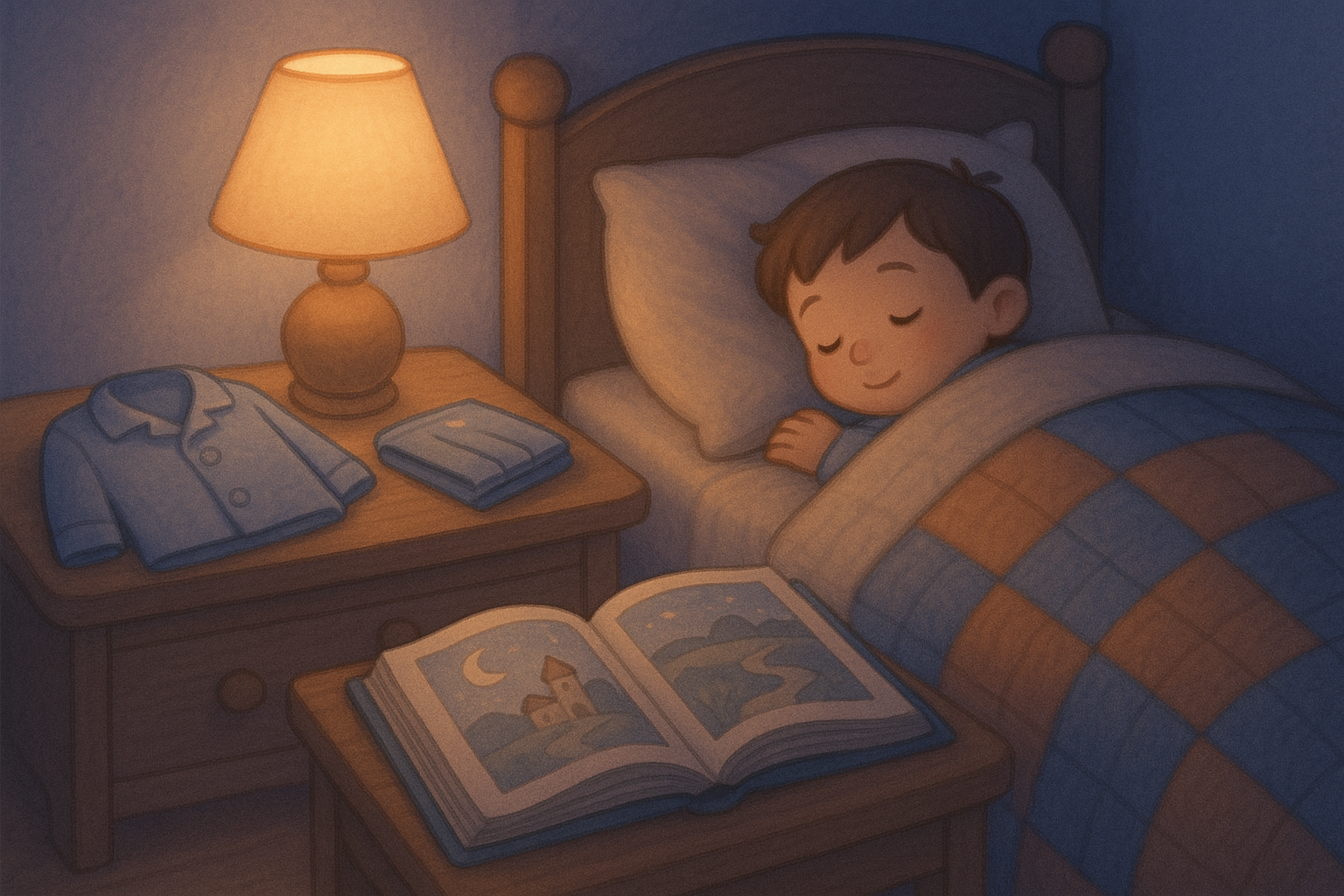
Why Wind-Down Beats Willpower at Lights-Out
You can't lecture a tired nervous system into sleep. If lights-out has become a battle of wills, here's the reframe that helps most families: wind-down beats willpower at lights-out—every time you actually build the runway.
Short answer: kids don't fall asleep because they suddenly develop iron discipline. They fall asleep when cues, lighting, pacing, and connection tell the body the day is closing. A short wind-down routine outperforms tougher rules because it works with biology, not against a depleted child (or parent).
Willpower is the wrong tool at 8:15
Willpower is a daytime resource. By bedtime, kids have spent it on school, sharing, sitting still, and not melting down in the grocery store. Parents have spent theirs on everything else.
So when we say, "Just go to sleep," we're asking for a skill that isn't available. It sounds like guidance. It lands like pressure.
What wind-down actually is
Wind-down is a predictable sequence that lowers stimulation and raises safety:
- Dimmer light
- Slower voice
- Simpler choices
- Familiar order of tasks
- A connection moment (story, song, quiet chat)
- A boringly consistent lights-out phrase
It's not spoiling. It's scaffolding.
Why the body listens to cues more than speeches
Brains track patterns. Pajamas after bath. Story after teeth. Same quilt corner. Same phrase. After enough nights, the sequence itself becomes sleepy. You're not convincing them. You're conditioning a soft landing.
That's why a perfect speech after a chaotic evening often fails—and a quiet, repeated routine succeeds on messy Tuesdays.
Willpower moves that backfire
- "Prove you're tired"
- Extra chores as punishment for stalling
- Taking away the comfort object mid-spiral
- Bright kitchen lights through the whole debate
- A new rule invented at the doorway
These can create short-term compliance and long-term bedtime dread.
Wind-down moves that usually help
- Start earlier than the meltdown—by 20 minutes if you can
- Flip the house to "evening mode" (lamps, quieter rooms)
- Offer two choices max ("blue pajamas or striped?")
- Keep story short enough to finish
- Leave after the plan you stated—not after the fifth encore
Personalized bedtime stories fit beautifully in step four: connection without a long invention burden. SlumberTales is built for that parent-led landing strip.
A 25-minute wind-down you can steal
- Minute 0–5: dim lights, announce evening mode
- 5–12: pajamas, teeth, bathroom (same order)
- 12–18: short story
- 18–22: water, stuffed companion job, one worry sentence if needed
- 22–25: lights-out phrase, leave, one planned check if promised
Adjust times. Keep the shape.
What about strong-willed kids?
Strong-willed often means strong need for predictability and dignity. Wind-down respects both. Give them a job in the routine (lamp helper, page turner). Hold the boundary on clock and screens. Flexibility lives inside the structure—not instead of it.
Travel, illness, and imperfect weeks
When life explodes, keep two anchors: the story (or song) and the lights-out phrase. Those travel better than a perfect schedule. Willpower lectures travel poorly.
Soft definition
Wind-down is a short, repeatable pre-sleep sequence that reduces stimulation and increases felt safety—so sleep can arrive without a willpower contest.
Measure success differently for two weeks
Don't grade wind-down by "fell asleep in three minutes." Grade it by fewer explosions, less bargaining, and a more predictable end. Sleep onset often improves after the fighting drops.
If one caregiver undermines the wind-down with exciting play "just for fun," align privately. Kids aren't manipulative masterminds—they're pattern detectors. Mixed signals keep the nervous system online.
On your worst nights, shrink the routine rather than scrap it. Even a two-step wind-down teaches the body something willpower speeches can't. Story + phrase can carry a chaotic evening if you protect those two steps.
If you share parenting with someone who loves high-energy tickle fights, schedule those earlier. Wind-down is not anti-fun; it is pro-timing. Fun still belongs in the house—just not as the last input before dark and quiet.
FAQ
Q: Isn't a routine just another way to control kids? A: A humane routine reduces nightly inventing for everyone. Kids usually relax when they can predict what happens next.
Q: How long until wind-down starts working? A: Some kids respond in a few nights; others need a couple of weeks of boring consistency. Expect protest while the old pattern fades.
Q: What if we don't have 25 minutes? A: Do a mini version: dim lights, teeth, two-minute story, same phrase. Short and consistent beats long and chaotic.
Q: Should I stay until they fall asleep? A: Families differ. If you stay, keep it boring and planned—not a new entertainment session. If you leave, follow through on any check-in you promise.
Q: Can wind-down include a show? A: Screens often undo the calm you're building. If you use media, park it earlier and keep the final stretch low-tech.
Q: What if my child uses willpower arguments ("I'll sleep later")? A: Don't debate the thesis. Return to the routine: "Story now. Lights next. We can talk more tomorrow."
Q: Do older kids still need wind-down? A: Yes—though it may look like reading, stretching, or a quiet playlist plus a consistent lights time. Biology doesn't vanish at age nine.
Q: Is this medical advice for insomnia? A: No. It's parenting support. If sleep problems are severe, loud snoring appears, or daytime function tanks, talk with a clinician.