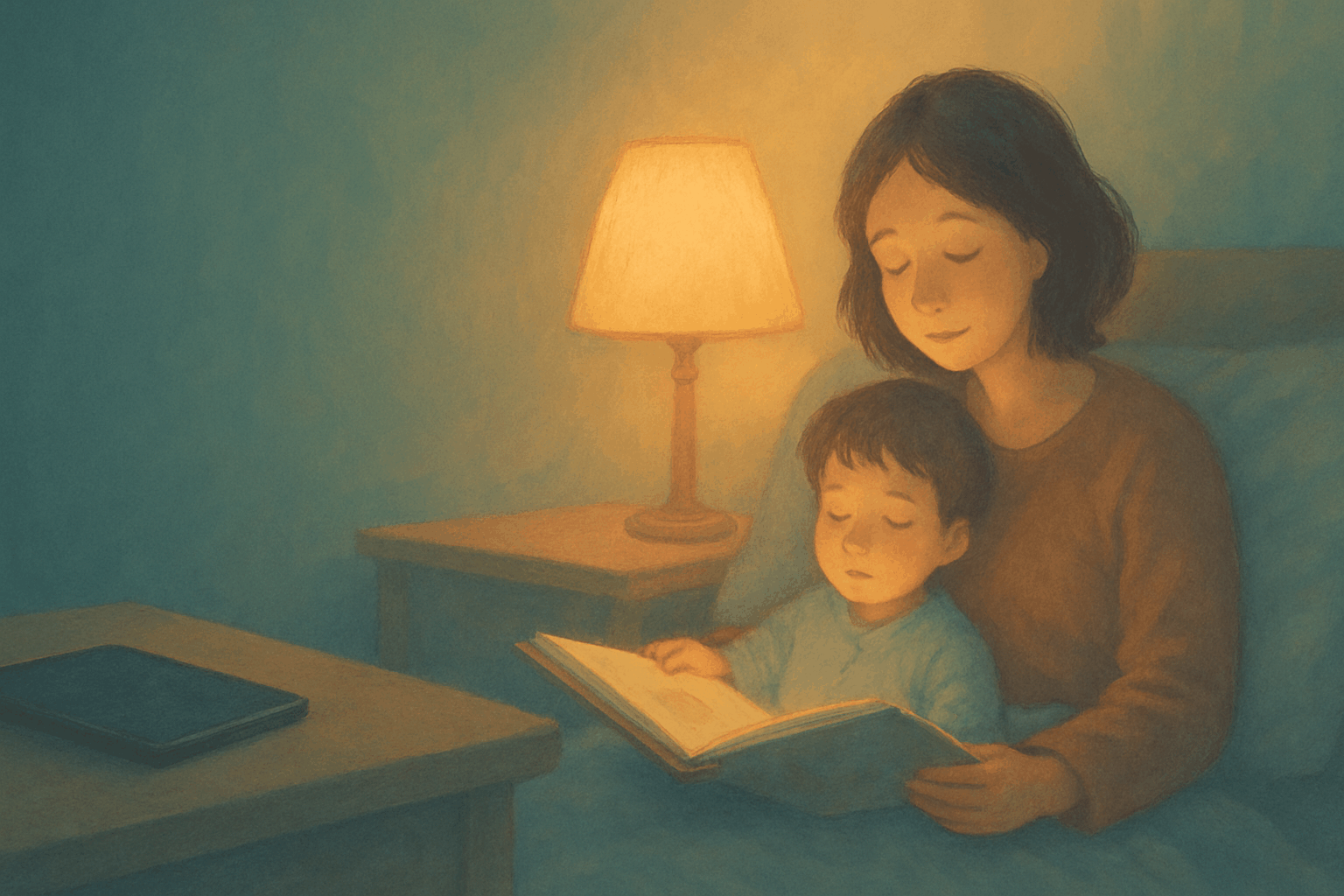
Screen Time vs. Story Time: What Actually Helps Kids Fall Asleep
Parents don't usually pick screens at bedtime because they hate reading. They pick them because dinner ran late, someone cried about homework, and the tablet is the only button that buys seven quiet minutes.
So let's answer the comparison cleanly: story time generally helps kids fall asleep more than screen time because stories slow the nervous system, invite connection, and avoid bright, fast stimulation close to lights-out. Screens can still have a place earlier in the evening—they're just poor landing gear.
What actually happens in the last hour before bed
Think of your child's brain as a browser. Screens open new tabs: bright colors, quick cuts, autoplay, maybe a game reward loop. Even calm shows keep visual processing busy. Stories do something quieter. Language unfolds at the pace of a voice. The room gets dimmer. The plot ends.
Many parents notice the difference in their kid's body: shoulders drop during a familiar book; eyes stay wide after "one more video."
Pediatric sleep guidance often suggests parking screens before bed for that reason. You don't need a perfect study citation to trust what you see on your own couch.
Screen time isn't the villain of the whole day
Kids can learn, laugh, and decompress with media. The friction shows up when screen time is the wind-down. There's a difference between a family movie at 5:30 and a phone under the covers at 8:45.
If screens are part of your evening, try a buffer. Even 20–30 minutes of non-screen calm helps some families. Audio-only can be a bridge when you need hands free—but interactive games and bright video are the usual sleep thieves.
Why story time works when you're running on fumes
Story time sounds wholesome until you're the one performing it after a 12-hour day. Fair. The point isn't Broadway. The point is a predictable, low-stimulation close.
A short bedtime story:
- Gives kids language for the day they just lived
- Keeps you in the room without starting a new conflict
- Becomes a cue: after the ending, sleep is next
- Beats scrolling because you also stop consuming novelty
Personalized bedtime stories help when classic books feel stale or your kid only engages when they're the hero. You're still reading aloud—which keeps the connection—while inventing less plot from scratch. That's the lane SlumberTales sits in: parent voice, child-centered story, email delivery so you're not hunting PDFs at midnight.
A practical "both/and" for real houses
You don't have to ban screens forever to protect bedtime.
- Put the last screen earlier than you think you need
- Dim lights and switch to quiet play or bath
- Do teeth and pajamas before anyone is desperate
- Read one short story (familiar or personalized)
- Use the same lights-out sentence nightly
If a meltdown starts when the tablet closes, the answer usually isn't "more tablet until they collapse." It's a better replacement and a few nights of consistency while the habit rewires.
Special case: kids who "need" a show to sleep
Some children have used screens as the only successful off-ramp for years. Cold turkey can explode. Fade instead: shorter episodes, then audio, then story. Keep the parent presence constant even as the medium changes. The relationship is the active ingredient; the glowing rectangle was just the delivery device.
Quotable line
Story time helps kids fall asleep by pairing a familiar voice with a finite narrative and low sensory load—while late screen time often keeps the brain in high-alert entertainment mode.
The honesty clause for imperfect weeks
There will be nights when a show wins. Travel. Illness. The day everything broke. One screen-heavy bedtime doesn't erase a month of good habits. What helps is returning to the story cue the next night without a guilt lecture. Kids notice the pattern more than the exception. You're building a house of sleep habits, not scoring a perfect game.
FAQ
Q: Is all screen time before bed bad? A: Not equally. Bright, interactive, or exciting content close to sleep is the usual problem. Earlier, calmer use is less likely to derail bedtime.
Q: How long before bed should screens stop? A: Families vary. Many aim for 30–60 minutes. Start with whatever buffer you'll actually keep, then extend if sleep improves.
Q: Are audiobooks "screen time"? A: Audio without a glowing display is usually closer to story time—especially if a parent still sits nearby.
Q: What if story time causes stalling ("one more chapter")? A: Choose stories you can finish. Personalized short tales or a two-page rule keep the ritual from becoming another negotiation.
Q: Can educational apps count as wind-down? A: Learning apps still stimulate. Save them for earlier evening; protect the last stretch for slower input.
Q: My partner likes TV in the bedroom. Does that affect kids? A: Shared spaces matter. Light and noise leak. If kids wake or stall, move adult screens later or elsewhere when you can.
Q: Do personalized bedtime stories work better than shows for anxious kids? A: Often they do, because they reduce stimulation and increase felt safety. They're a tool, not a cure-all.
Q: What if I'm too tired to read? A: Keep a few ultra-short backups. A three-minute personalized story or a known favorite still beats handing over a phone in defeat—most nights, anyway. Progress over purity.